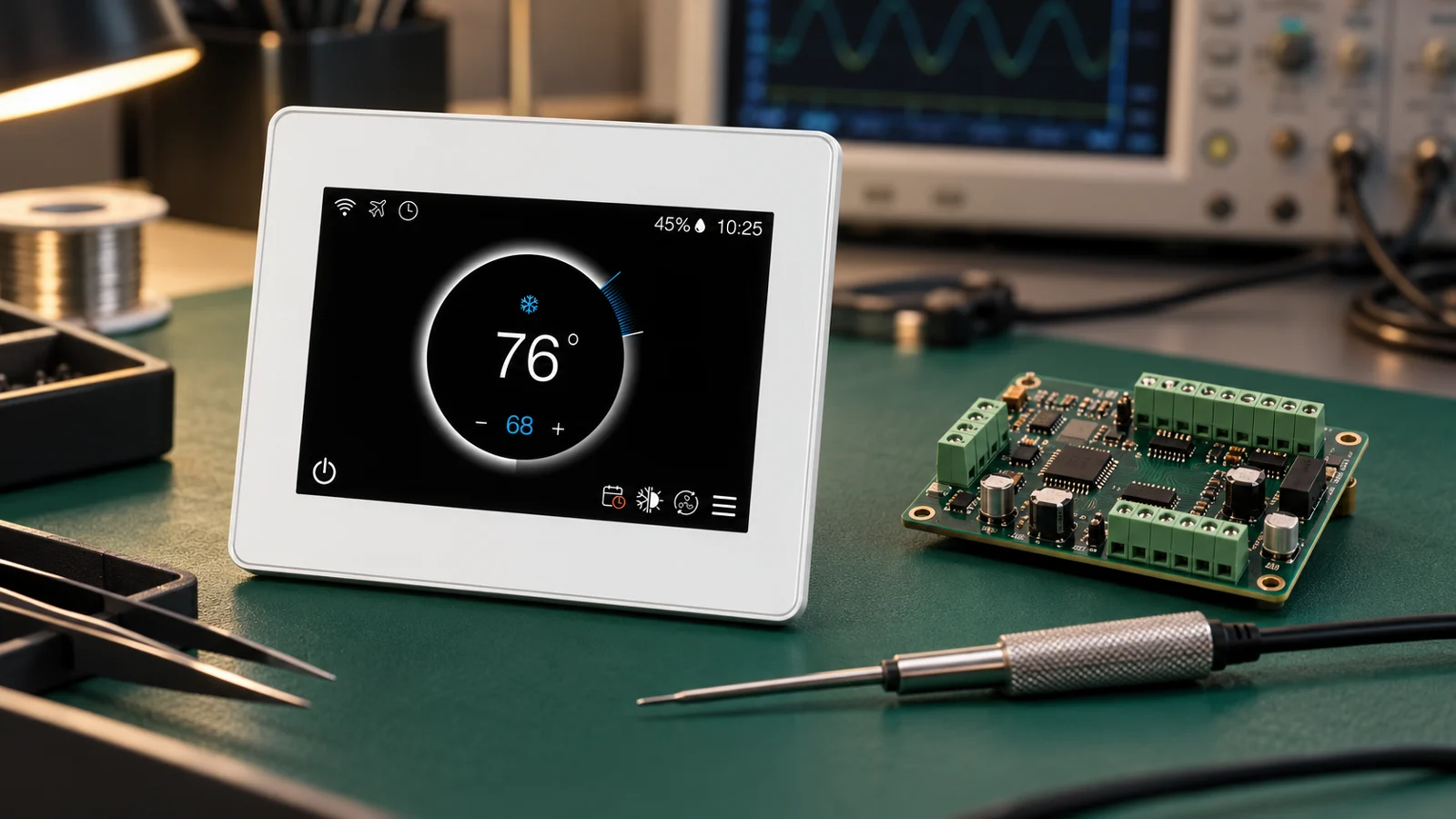
HVAC control engineering. From hardware to connected systems.
FUMRON develops HVAC controllers around your equipment, control sequences and integration requirements. Our HVAC OEM/ODM Services cover PCB design, power circuits, embedded firmware, touchscreen interfaces and communication protocols—from initial requirements through production and ongoing technical support.
Custom Thermostat Development connects electrical design, device behaviour, user experience and production validation.
01
Hardware Engineering
Designed around the electrical demands of your HVAC system.
PCB and I/O development
Develop embedded PCB layouts and input/output configurations around temperature sensing, equipment interfaces, relay outputs and modulation requirements.
Power stability and low-power design
Engineer power modules and circuit protection around the supply conditions, standby consumption and operating environment specified for the product.
Display and component selection
Select TFT displays, glass touch panels and electronic components against defined requirements for electrical performance, environmental exposure and service life.
02
Firmware & Protocol Engineering
Connect device behaviour with system-level requirements.
Embedded Firmware
Implement temperature-control sequences, scheduling, sensor processing, fault handling and equipment-protection logic for the target application.
Protocol Customization
Develop Modbus RTU / Modbus TCP register maps, BACnet MS/TP / BACnet IP object mappings, LoRaWAN payloads and MQTT messaging around the required data points and control functions.
Wireless and IoT integration
Integrate Tuya/Smart Life and Tuya Zigbee connectivity and customized RF communication, with testing for pairing, command handling, connection recovery and hardware–firmware interaction.
03
Quality Assurance & Testing
Verify performance against defined acceptance criteria.
RF and communication testing
Evaluate transmit power, communication reliability and interference behaviour under documented test conditions.
Environmental and endurance testing
Assess operation at specified high and low temperatures, alongside ageing tests and repeated operating cycles.
Industrial Grade Quality Control
Translate approved specifications into incoming inspection, in-process checks and finished-product functional tests, supported by documented acceptance criteria.
04
UI & Industrial Design
Make complex control functions clear at the point of use.
Custom TFT interfaces
Adapt screen layouts, operating modes, language content, icons and brand identity to the intended users and installation environment.
Interaction design
Define navigation, parameter access, status feedback and installer settings to support everyday operation and commissioning.
Mechanical and enclosure development
Coordinate glass panels, enclosure geometry, mounting features and tooling requirements with PCB layout, assembly and branded packaging.
Review the application, supply voltage, I/O, control sequence, protocols, mechanical constraints and target markets.
REVIEW MILESTONE
Agreed specification, development scope and acceptance criteria.
02
Hardware & Software Prototyping
Develop PCB prototypes, embedded firmware, communication interfaces and UI concepts.
REVIEW MILESTONE
Engineering samples reviewed against the agreed requirements.
03
Sample Testing & Certification
Validate electrical functions, control behaviour, interoperability, RF performance and environmental operation. Coordinate applicable compliance testing and certification activities.
REVIEW MILESTONE
Recorded test results, corrective actions and sample approval.
04
Mass Production
Transfer the approved design into production with controlled hardware, firmware, assembly instructions and inspection procedures.
REVIEW MILESTONE
Pilot-build approval and production release.
05
Ongoing Support
Support integration, investigate field issues and manage firmware updates or product revisions.
REVIEW MILESTONE
Documented changes with regression testing appropriate to their impact.
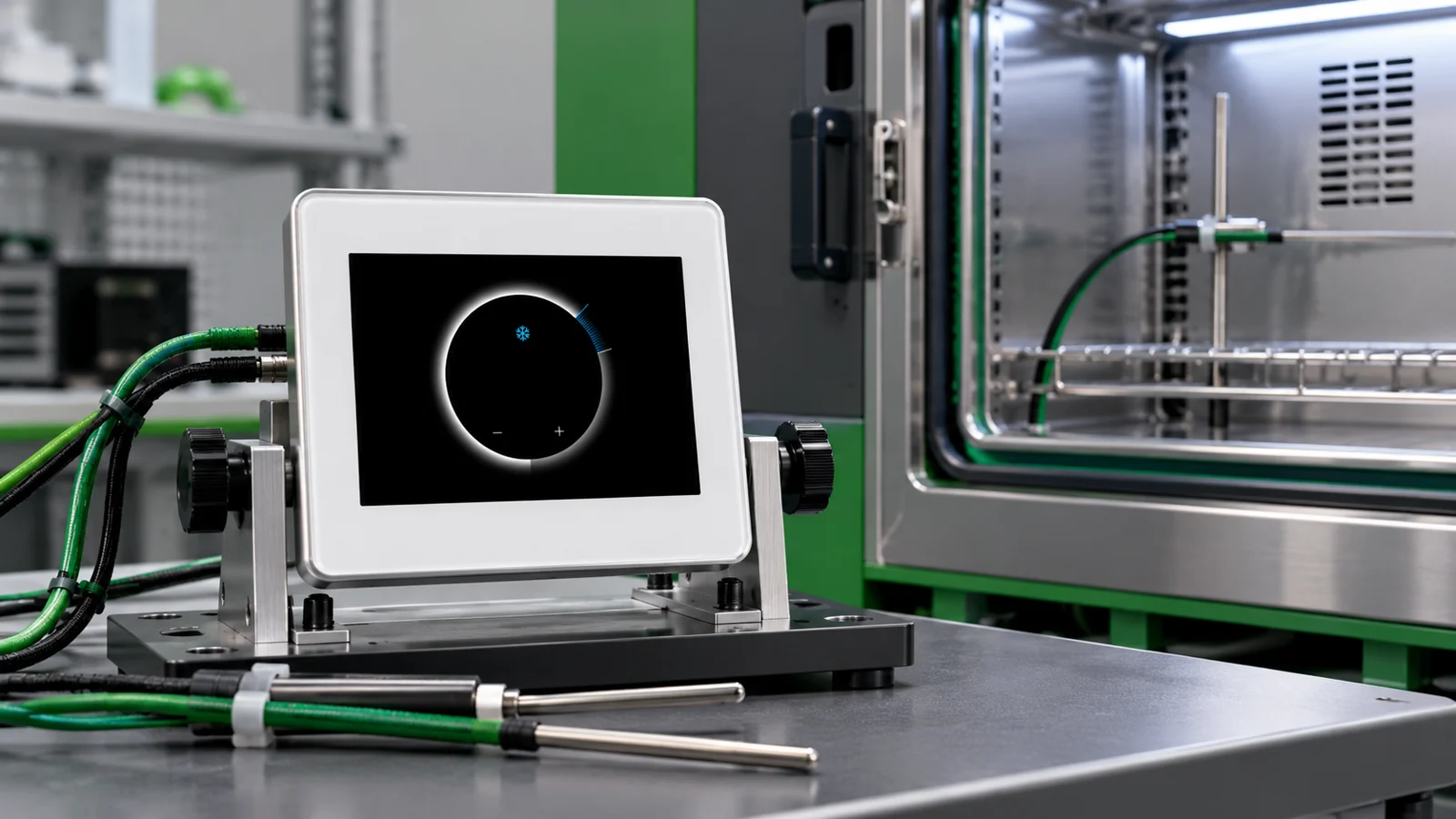
Engineering visualization · illustrative setup
TESTING & COMPLIANCE ASSURANCE
Engineering evidence for product approval.
Custom Thermostat Development requires measurable requirements and repeatable verification. The validation plan should connect each critical requirement to its test method, operating conditions and pass/fail criteria.
Electrical performance
Supply stability, I/O operation, sensor behaviour and protective functions.
Communication performance
Protocol data exchange, RF transmit power, pairing reliability and recovery after interrupted connections.
Environmental reliability
High- and low-temperature operation, ageing and repeated functional cycles.
EMC and market compliance
Electromagnetic compatibility and applicable radio requirements, with CE conformity activities defined for the final product configuration.
Compliance scope follows the product’s hardware, radio configuration, intended use and destination market. For North American projects, applicable regulatory and customer approval requirements are established during requirements assessment.
YOUR NEXT ENGINEERING STEP
Bring your control requirements.
Prepare your engineering drawings, existing controller specifications or system architecture for a focused technical review. Start with the information you have.